Winds are caused by differences in air pressure due to the unequal heating of the Earth's surface. There are two main types of winds: local winds and global winds.
LOCAL WINDS:
Local winds are winds that blow from any direction and cover shorter distances. There are two main types of local winds, the sea breeze and the land breeze. A sea breeze is the flow of air from the sea to the land. It occurs during the day. Air over land is usually warmer than the air over the sea or any other body of water during the day. This is because land heats up faster during the day. The air over the land rises and in its place comes the cooler air from above the sea. The breeze you feel on a summer day at a beach is this sea breeze.

A land breeze is the flow of air from the land to the sea. It occurs during the night. Air over land is usually cooler than the air over the sea during the night. This means the warm air from the sea rises and the cool air from the land moves to take its place. After a sunset, if you are the beach, you have felt a land breeze. Another name for a land breeze is an off-shore breeze.

(pictures made by me...=])
GLOBAL WINDS:
Global winds are winds that blow from a specific direction and usually cover longer distances than local winds. In the Northern Hemisphere, winds curve to the right as they move. In the Southern Hemisphere, winds curve to the left as they move. This is caused by the Coriolis effect, the shift in wind direction. There are four main global wind systems: the doldrums, the trade winds, the prevailing westerlies, and the polar easterlies.
The doldrums are located at the equator. These winds are surface winds that are very calm. Doldrums also receive a lot of the Sun's radiant energy. However, they are a problem for sailing ships.
The trade winds are located at 30° North and South of the equator**. In this area, the skies are usually clear and there is little rainfall. A trade wind is the air moving back towards the equator to form a belt of warm, steady winds. The warm air rises from the equator and cools and begins to sinks. These winds, unlike the doldrums, help sailing ships and airplanes.
**The name of these latitudes is the Horse Latitudes. This is where sailors used to throw horse off their boat because they either ran out of food for the horses or needed to get rid of weight.
The prevailing westerlies are located from 40° to 60° latitude in both hemispheres. The prevailing westerlies are string winds. This type of global wind is the cool, sinking air that moves towards the poles.
The polar easterlies are located at the poles. These winds are cold, weak winds that travel from the poles to the equator. The polar easterlies cause the weather to change in the United States.
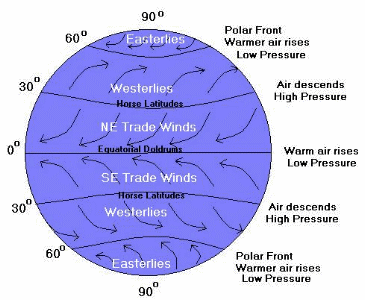
PICTURE from: http://www.weatherwizkids.com/globalcirculation.gif
Learning about the different winds that blow was interesting because I learned about the everyday wind processes. It is important to know about the Earth's processes, and winds are a very big part of the Earth.
Some interesting facts:
1. Some types of local winds blow under certain circumstances because they need a certain temperature to blow.
SOURCE: Wikipedia
Hyperlink: http://en.wikipedia.org/wiki/Wind#Local_winds
2. Air flows are caused by the Sun's heat energy, and air flows try to free themselves of this heat energy.
SOURCE: Dr. David P. Stern
Hyperlink: http://www-istp.gsfc.nasa.gov/stargaze/Sweather2.htm


1 comments:
i like your pictures (: theyre pretty!
and your new background..
Post a Comment